


NEET to JEE: Why India’s Examination System Faces a Growing Credibility Challenge
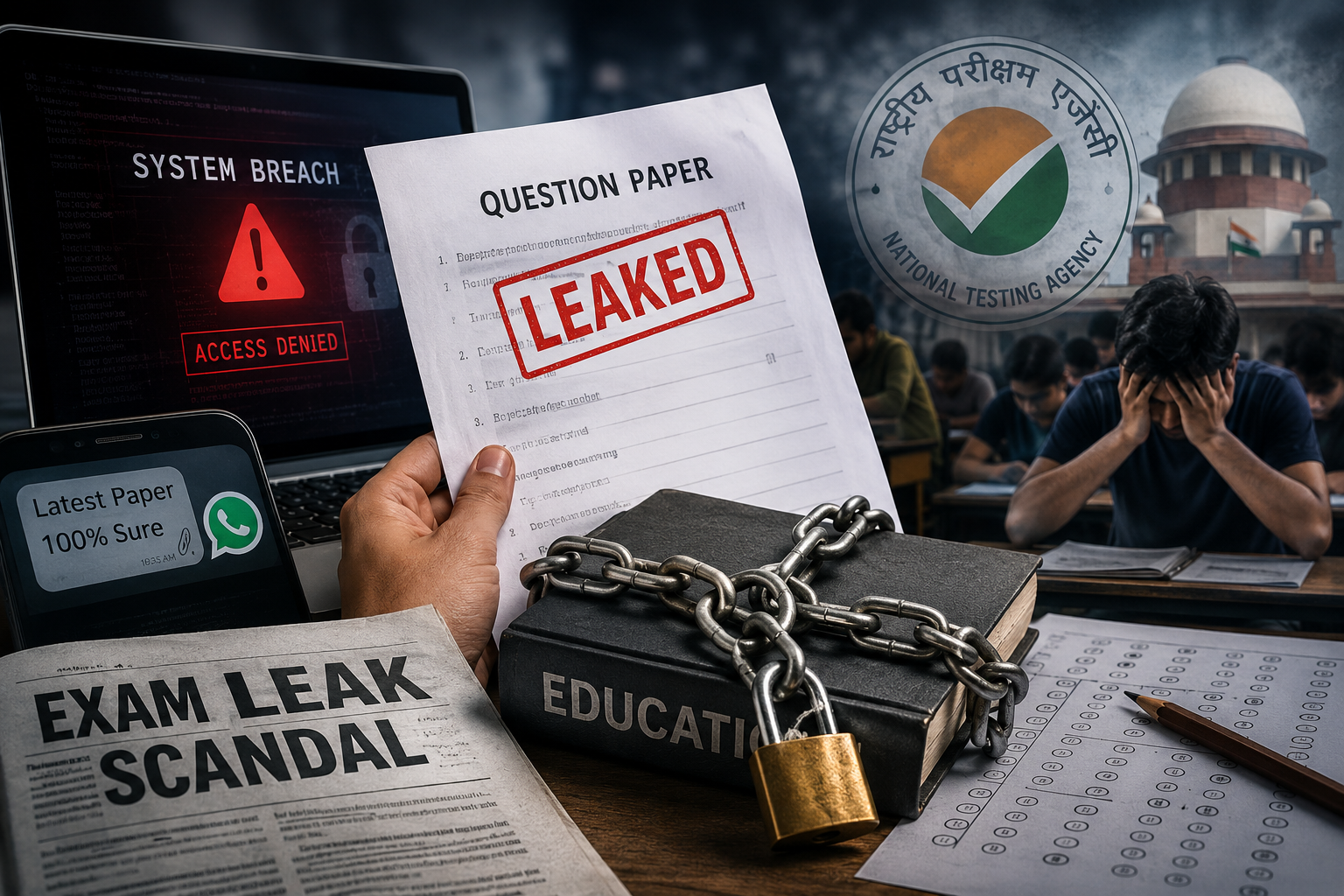
Repeated controversies surrounding major Indian examinations,
including NEET-UG, JEE Main, CBSE assessments and various computer-based recruitment
tests, have reignited concerns over the integrity of the country’s examination system.
Education experts argue that the recurring incidents of alleged paper leaks, technical failures and
administrative shortcomings are not isolated events but symptoms of deeper structural
weaknesses that have developed over many years.
A System Under Increasing Pressure
India’s competitive examination system plays a decisive role in determining the academic and
professional futures of millions of students. Entrance examinations for medicine, engineering
and government recruitment attract enormous participation each year, creating intense
competition for a limited number of seats and positions.
In the case of medical admissions, millions of candidates compete for a comparatively small
number of government-funded seats. As a result, even a marginal difference in marks can
significantly influence a student’s future prospects.
Experts believe this intense competition has created a lucrative underground market for
examination fraud, including alleged paper leaks, answer-key sales and other illegal activities.
Security Concerns and Insider Risks
Investigations into several examination controversies have suggested that breaches are often
linked not only to external actors but also to individuals with authorised access to examination
systems.
Education analysts note that examination security can be compromised when insiders involved in
printing, logistics, distribution or examination center operations misuse their positions. Such
vulnerabilities remain a major challenge even when advanced technological safeguards are in
place.
Operational Challenges Within Examination Authorities
Observers have also highlighted concerns regarding staffing shortages and heavy dependence on
outsourced service providers within some examination bodies.
The involvement of multiple contractors in question paper logistics, information technology
systems, examination centre management, scanning and evaluation processes can increase
operational complexity and create additional points of vulnerability.According to education policy experts, stronger oversight and greater institutional capacity may
be required to reduce these risks.
Technology Is Not a Complete Solution
While many policymakers view computer-based examinations as a way to reduce opportunities
for malpractice, experts caution that technology alone cannot eliminate all risks.
Paper leaks may still occur before examinations are conducted, while technical failures, server
outages and cybersecurity threats can disrupt examination processes and affect candidates.
Recent technical disruptions reported during computer-based examinations have highlighted the
need for robust digital infrastructure and contingency planning.
Growing Concerns Over Accountability
Several major examinations in recent years have been affected by allegations ranging from paper
leaks and answer-key disputes to marking errors and administrative lapses.
Critics argue that corrective action is often reactive rather than preventive, with investigations
and reforms frequently occurring only after public pressure, media scrutiny or judicial
intervention.
Impact on India’s International Academic Reputation
Education specialists generally believe that India’s academic reputation remains strong
internationally. Universities across the United Kingdom, United States, Canada and Australia
continue to admit large numbers of Indian students and recognise the country’s significant
academic talent pool.
However, repeated examination controversies may gradually influence how international
institutions assess Indian academic credentials.
Many global universities already evaluate applicants using a combination of academic
transcripts, examination results, personal statements, recommendation letters, interviews and
evidence of extracurricular achievement. Some experts suggest that continued examination
controversies could encourage universities to place greater emphasis on holistic assessment
methods and independent verification procedures.
The Greatest Cost: Loss of Student Confidence
While concerns about international recognition remain important, many analysts believe the
more immediate consequence is the erosion of trust among students themselves.
When candidates perceive that examination outcomes may be influenced by leaks, administrative
failures or technical problems, confidence in the fairness of the system can decline significantly.Such perceptions may contribute to increased stress levels, greater dependence on private
coaching institutions, rising interest in overseas education and reduced faith in public
institutions.
Calls for Reform
Education policy experts have proposed a range of reforms aimed at strengthening examination
integrity, including:
Expanded use of secure computer-based testing where appropriate.
Enhanced cybersecurity and encrypted question-paper distribution systems.
Independent audits of examination processes.
Reduced reliance on outsourced critical operations.
Stronger criminal penalties for organised examination fraud networks.
Artificial intelligence-based monitoring of examination centers.
Greater transparency in evaluation and result-processing procedures.
Faster investigations and public disclosure of findings.
Looking Ahead
Experts agree that India’s examination challenges are fundamentally issues of governance,
security and accountability rather than a reflection of student ability.
Indian students continue to achieve success at some of the world’s leading institutions, including
the University of Oxford, the University of Cambridge and the Massachusetts Institute of
Technology.
However, education observers warn that unless meaningful reforms are implemented, repeated
examination controversies could gradually weaken confidence in India’s testing systems and
increase demands for additional verification by academic institutions both at home and abroad.
For a nation that views education as one of its most important pathways to economic and social
advancement, restoring trust in the examination process may prove to be one of the most critical
policy challenges of the coming decade.
Share this post :
Facebook
Twitter
LinkedIn
Pinterest
Latest News

Can America Really Isolate Iran? The Limits of Economic Warfare in a Divided World
August 27, 2026
No Comments

Artificial Intelligence Must Serve Humanity, Not Just Shareholders
August 7, 2026
No Comments

Is India’s Young Generation Preparing to Overturn Traditional Politics?
August 4, 2026
No Comments