


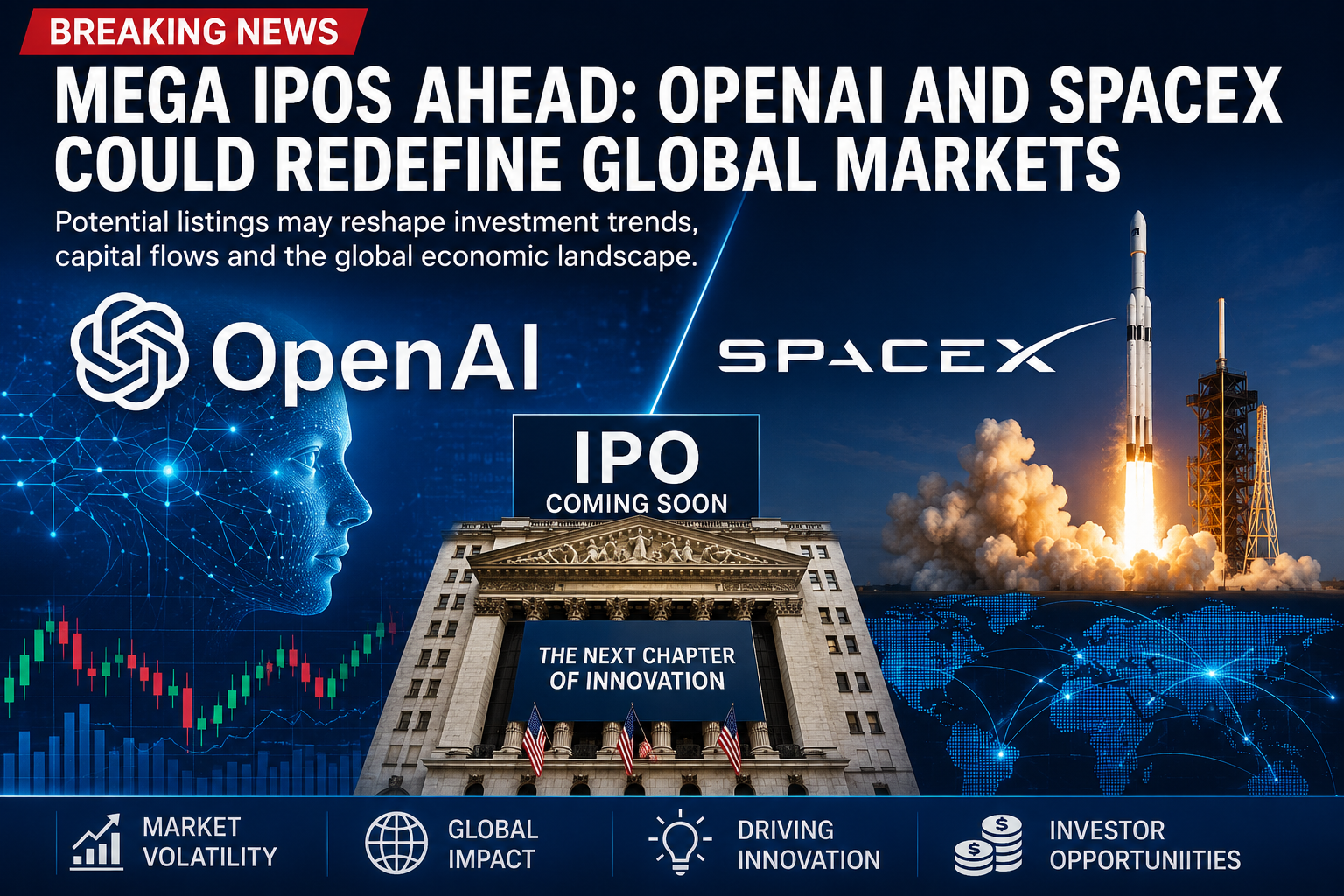
Mega IPOs of OpenAI and SpaceX Could Redefine Global Markets and the Future of Innovation
Potential public listings by two of the world’s most influential technology companies may reshape investment trends, capital flows and the global economic landscape.
By Global News Desk
The prospect of two of the world’s most prominent technology companies entering the public markets has captured the attention of investors, economists and policymakers alike. Reports suggesting that OpenAI has confidentially filed for an initial public offering (IPO), alongside expectations that Elon Musk’s SpaceX is preparing for what could become the largest IPO in history, have sparked widespread debate about their potential impact on global financial markets.
If both companies proceed with their listings, these events would represent far more than major fundraising exercises. They could mark the beginning of a new era in which artificial intelligence and commercial space exploration emerge as dominant forces shaping the global economy.
A New Era for Investors
OpenAI has become one of the defining companies of the artificial intelligence revolution, developing technologies that are transforming industries including healthcare, education, finance and manufacturing. At the same time, SpaceX has fundamentally altered the aerospace sector by reducing launch costs, expanding satellite communications through Starlink and pursuing ambitious long-term plans for human space exploration.
Investor enthusiasm surrounding both companies reflects growing confidence in innovation-led growth. However, market analysts caution that offerings of this magnitude could also create significant short-term disruptions.
Potential Impact on Global Stock Markets
Large IPOs often result in a substantial reallocation of investment capital. Institutional investors, such as pension funds, sovereign wealth funds and asset management firms, may sell existing holdings to participate in these highly anticipated offerings.
This shift in capital could increase volatility across equity markets. Established technology companies may experience temporary selling pressure as investors seek exposure to newly listed firms perceived to offer stronger growth prospects.
Emerging markets could also feel the effects. Foreign institutional investors may redirect funds from developing economies towards the United States to secure positions in these landmark listings. Such movements could influence market performance across Asia, Latin America and parts of Africa.
Driving Innovation and Economic Growth
Despite concerns about short-term market instability, many economists believe that successful IPOs by OpenAI and SpaceX could deliver long-term economic benefits.
Public listings would provide both companies with access to substantial capital, enabling further investment in research, product development and global expansion. Increased funding for artificial intelligence could accelerate productivity improvements across multiple sectors, while advances in space technology may generate new opportunities in communications, navigation, environmental monitoring and scientific research.
The broader technology ecosystem could also benefit. Smaller firms operating within AI and aerospace supply chains may attract greater investor interest, potentially stimulating entrepreneurship and innovation worldwide.
Concerns Over Valuations
While optimism remains strong, some analysts have urged caution.
Financial history demonstrates that periods of technological transformation can sometimes give rise to excessive speculation. Comparisons have already been drawn with the dot-com boom of the late 1990s, when soaring valuations ultimately led to significant market corrections.
Should OpenAI and SpaceX achieve exceptionally high market valuations, investors may question whether expectations have moved ahead of commercial realities. The challenge for markets will be to distinguish between genuine long-term value creation and speculative enthusiasm.
The Risk of Greater Market Concentration
Another concern relates to the increasing concentration of global equity markets.
A relatively small number of technology companies already account for a significant proportion of major stock market indices. The addition of new trillion-dollar enterprises could further amplify the influence of a handful of firms over global investment portfolios.
This concentration may increase systemic risks, leaving markets more vulnerable to setbacks affecting a limited group of dominant companies.
Implications for the Global Economy
The ultimate economic impact of these potential IPOs will depend largely on whether investor confidence translates into sustainable business performance.
Supporters argue that the expansion of artificial intelligence and commercial space industries could drive productivity gains, create highly skilled employment opportunities and contribute to long-term economic growth.
Critics, however, warn that excessive optimism and inflated asset prices could heighten financial vulnerabilities if companies fail to meet market expectations.
What Investors Should Watch
As anticipation builds, market participants are likely to focus on several key factors:
- The final valuations assigned to OpenAI and SpaceX;
- The scale of investor demand during the offering process;
- The extent to which existing investments are liquidated to fund participation;
- The regulatory frameworks governing the IPOs; and
- Each company’s ability to demonstrate a credible path towards sustainable profitability.
A Defining Moment for Capital Markets
Whether regarded as a celebration of technological progress or a test of market discipline, the possible public listings of OpenAI and SpaceX represent a defining moment in modern finance.
Their entry into public markets could accelerate investment in transformative technologies that reshape industries and societies. At the same time, they may challenge investors to balance optimism with prudence in an era characterised by rapid technological advancement.
If these IPOs proceed successfully, they may not only redefine corporate valuations but also influence the future trajectory of global economic growth. The world will undoubtedly be watching closely.
Editor’s Note: This article is based on market reports and industry speculation regarding potential future IPO activity. Any decision to proceed with a public offering remains subject to regulatory approval, official company announcements and prevailing market conditions.
Share this post :
Facebook
Twitter
LinkedIn
Pinterest
Latest News


Iran Missile Strikes on Israeli Air Bases Raise Fears of Renewed Regional Conflict
June 9, 2026
No Comments

Iran-US Deadlock Sparks Fresh Oil Market Concerns
June 5, 2026
No Comments