


Asia’s Hidden Economic Crisis: How the Iran Conflict Could Trigger Inflation, Currency Pressures and a Global Slowdown.
By Global News Desk
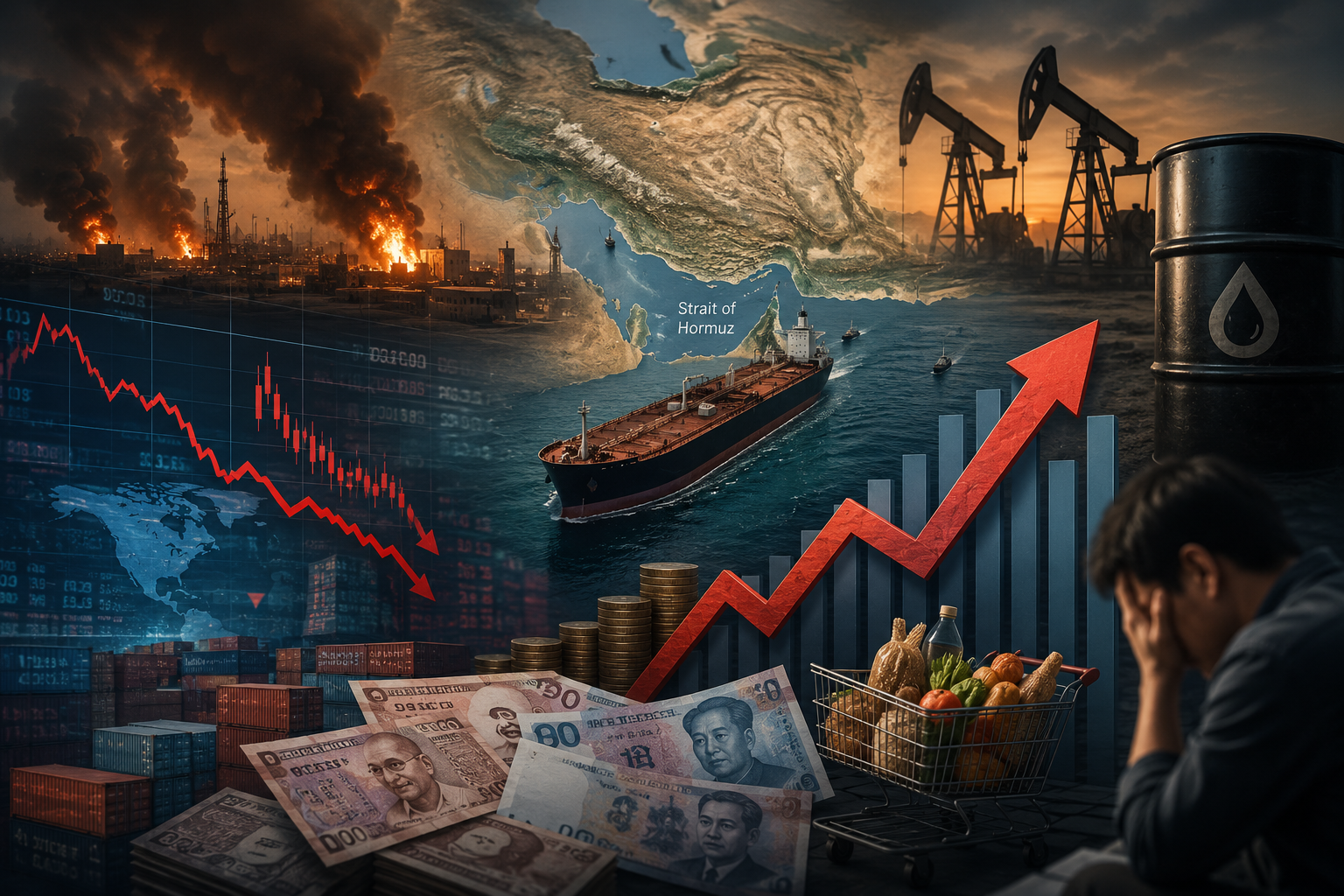
As tensions in the Middle East continue to escalate, economists are warning that the consequences of the Iran conflict could extend far beyond the region’s borders. While attention remains focused on the geopolitical and humanitarian dimensions of the crisis, a quieter but potentially devastating economic story is unfolding across Asia.
Excluding China, several Asian economies are facing heightened risks of currency depreciation and rising inflation as a result of higher energy prices and disruptions to global oil supply routes. The greatest concern centres on the Strait of Hormuz, a narrow maritime passage through which approximately one-fifth of the world’s seaborne oil trade passes. Any prolonged disruption to this critical route threatens to increase energy costs, strain government finances and weaken already fragile currencies.
Asia’s Most Vulnerable Economies
Countries that depend heavily on imported oil and possess limited foreign exchange reserves are expected to bear the brunt of the economic fallout.
India, with a population of approximately 1.46 billion and a nominal GDP of around US$4.3 trillion, remains one of the world’s largest oil importers. Sustained increases in crude oil prices could place significant pressure on the Indian rupee, contribute to higher inflation and slow economic growth.
In Pakistan, where foreign exchange reserves remain constrained, the economic risks are even more pronounced. With a population of around 255 million and a GDP of approximately US$380 billion, the country faces the prospect of further depreciation of the Pakistani rupee, rising import costs and intensified inflationary pressures.
Bangladesh, home to around 175 million people, has emerged as one of Asia’s fastest-growing economies in recent years. However, its reliance on imported fuel leaves it exposed to external shocks. Higher energy prices could increase pressure on the taka and widen the country’s balance of payments deficit.
Meanwhile, Sri Lanka, which is still recovering from the severe economic crisis of 2022–23, remains vulnerable to renewed energy shocks. With a population of approximately 22 million and a GDP of around US$95 billion, the island nation may face renewed inflationary pressures and constraints on economic recovery.
The Philippines is also at risk. Rising fuel costs have already weakened the peso, and further escalation in oil prices could increase inflation and place additional pressure on public finances.
Other Asian economies, including Thailand, Vietnam, Japan and South Korea, are not immune. However, their comparatively stronger financial systems and larger foreign exchange reserves may provide a greater degree of resilience against prolonged external shocks.
The Wider Threat to Global Growth
The implications of a prolonged Iran conflict extend well beyond Asia.
The extent of the economic impact on global GDP will depend largely on the duration of the conflict and the degree to which oil shipments through the Strait of Hormuz are affected.
Under a short-term disruption lasting one to two months, with oil prices averaging between US$80 and US$90 per barrel, the impact on global growth is likely to remain limited.
However, a moderate disruption lasting between three and six months, with oil prices rising to between US$90 and US$110 per barrel, could reduce global GDP growth by between 0.3 and 0.6 percentage points.
In a more severe scenario involving substantial disruption to oil flows through the Strait of Hormuz, oil prices could exceed US$120 per barrel. In such circumstances, global economic growth could slow by as much as 0.7 to 1.5 percentage points.
Higher energy prices increase the cost of transportation, manufacturing and agricultural production. Businesses often pass these costs on to consumers, reducing household purchasing power and dampening economic activity. Import-dependent economies in both Asia and Europe would be particularly vulnerable.
Employment Risks Around the World
The effects on employment typically emerge several months after the initial economic shock.
Industries that rely heavily on energy consumption are likely to face increased pressure. Manufacturing sectors may experience reduced output as production costs rise. Transport and logistics companies could see profitability decline due to higher fuel expenses. Airlines and tourism operators may confront weaker demand as travel becomes more expensive.
Small and medium-sized enterprises, particularly in emerging economies with limited access to financing, could find it increasingly difficult to absorb higher operating costs.
Countries such as India, Pakistan, Bangladesh and Sri Lanka may witness greater employment challenges due to their large labour-intensive industries and limited fiscal flexibility.
At the same time, some sectors could benefit from shifting economic priorities. Renewable energy projects, domestic oil and gas production, defence manufacturing and energy efficiency initiatives may experience increased investment and job creation.
Potential Winners from Higher Energy Prices
Not all economies would suffer equally from sustained increases in oil prices.
Major energy exporters, including Saudi Arabia, the United Arab Emirates, Norway and Canada, could benefit from higher export revenues and improved fiscal positions. Nevertheless, even these countries would remain exposed to broader financial market volatility and potential reductions in global demand.
A Defining Economic Test
The greatest economic threat posed by the Iran conflict lies not solely in the hostilities themselves, but in the possibility of a prolonged disruption to global energy supplies.
If oil prices remain elevated above US$100 to US$120 per barrel for several quarters, the consequences could include slower global economic growth, higher inflation, weaker consumer confidence, reduced business investment and increased unemployment in vulnerable economies.
History demonstrates that major oil shocks have frequently preceded periods of economic slowdown. Whether the world avoids another such episode will depend on diplomatic efforts to de-escalate tensions, the continued security of critical shipping routes and the ability of governments and central banks to respond effectively to emerging risks.
For Asia’s most vulnerable economies, the coming months could prove to be a crucial test of economic resilience. For the global economy, the stakes are considerably higher: a regional conflict has the potential to evolve into a worldwide economic challenge.
Share this post :
Facebook
Twitter
LinkedIn
Pinterest
Latest News

Mega IPOs of OpenAI and SpaceX Could Redefine Global Markets and the Future of Innovation
June 10, 2026
No Comments
Iran Missile Strikes on Israeli Air Bases Raise Fears of Renewed Regional Conflict
June 9, 2026
No Comments
Iran-US Deadlock Sparks Fresh Oil Market Concerns
June 5, 2026
No Comments