


The Great Indian Paradox: Why We Are Starving While Our Bins Are Full
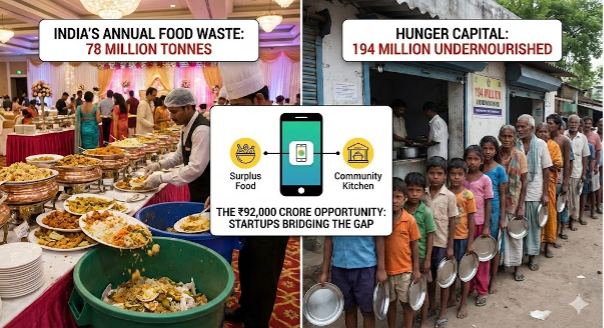
In the time it takes you to read this sentence, thousands of kilograms of perfectly edible food will be dumped into Indian landfills. In that same timeframe, a child in a remote district of Bihar or a slum in Mumbai will cry themselves to sleep on an empty stomach.
This is the tale of two Indias. One is an agricultural powerhouse, the world’s second-largest producer of food. The other is ranked 105th out of 127 countries in the Global Hunger Index (2024). We are currently in the “Serious” category of hunger severity, trailing behind neighbors like Nepal and Sri Lanka.
But here is the statistic that should keep every policymaker and CEO awake at night: India throws away approximately 78 million tonnes of food every year.
The Math of Cruelty: What We Could Have Done
To understand the sheer scale of this tragedy, we need to move beyond abstract numbers. 78 million tonnes isn’t just a statistic; it is a crime against humanity.
- The “Bihar” Equivalent: The food we waste annually is enough to feed the entire population of Bihar—over 100 million people—for a full year.
- The Daily Deficit: 194 million Indians go undernourished daily. If we recovered just one-fourth of the food currently wasted, we could eradicate hunger in India. Not reduce it—eradicate it.
We are not facing a production crisis; we are facing a distribution catastrophe. We are growing enough food to feed 1.5 billion people, but our bins are eating better than our poor.
The Economic Drain: ₹92,000 Crore into the Dustbin
While the moral cost is incalculable, the financial cost is precise. Estimates suggest that food waste costs the Indian economy upwards of ₹92,000 Crore ($11 Billion) annually.
This isn’t just “lost revenue.” This is:
- Wasted Water: Agriculture consumes 80% of India’s fresh water. When you throw away a bowl of rice, you aren’t just wasting grain; you are flushing down the 2,500 liters of water it took to grow that kilogram of rice. In a water-stressed nation, this is suicidal.5
- Inflationary Pressure: When 40% of produce rots in transit due to poor cold chains, the remaining 60% becomes more expensive. The middle-class consumer pays the price for this inefficiency at the checkout counter.
- Environmental Suicide: Our landfills—Ghazipur, Deonar, Bhalswa—are overflowing. Rotting food releases Methane, which is 28 times more potent than CO2. We are literally poisoning our air to dispose of the food we failed to eat.
The Silver Lining: The ‘Waste-to-Wealth’ Startup Boom
If there is hope, it lies in India’s entrepreneurial spirit. Recognizing that the government alone cannot plug these leaks, a new wave of startups is turning this crisis into a business model. They are proving that you can feed the hungry and make a profit.
- The “Robin Hood” Aggregators
Startups and non-profits like No Food Waste and Zomato’s Feeding India are treating hunger as a logistics problem.6 They use technology to map “Hunger Spots” and “Surplus Spots” (weddings, corporate cafeterias), moving excess food to the needy in real-time.
- Fixing the Broken Supply Chain (Farm-to-Fork)
The biggest bleed happens before the food even reaches the consumer.
- WayCool and DeHaat are using tech-enabled supply chains to reduce handling times. By connecting farmers directly to retailers and using predictive analytics, they have drastically reduced the 40% post-harvest loss typical in Indian agriculture.
- Cold Chain Innovation: Startups are developing solar-powered cold storage units for rural India, ensuring that a farmer’s tomato harvest survives the heat long enough to reach the mandi.
- The Bio-Science Revolution
For food that cannot be eaten, it shouldn’t be wasted.
- Loopworm is an Indian biotech startup farming Black Soldier Fly larvae on food waste. These insects convert waste into high-quality protein feed for shrimp and poultry. It’s a perfect circular economy: Food waste Insect Protein Feed for Animals Food for Humans.
- Buyofuel is an online marketplace connecting waste generators with biofuel manufacturers, ensuring that organic waste powers factories instead of polluting landfills.
The Wake-Up Call
The trillion $ global opportunity mentioned by analysts is real, but for India, the stakes are higher than just GDP.
We cannot aspire to be a “Vishwaguru” (World Leader) or a $5 Trillion economy while wasting enough food to feed a small nation. The solution requires a three-pronged attack: Consumer Awareness (stop wasting at weddings), Corporate Innovation (fix the supply chain), and Government Policy (penalize bulk waste).
The food is there. The mouths are waiting. The only thing missing is the will to connect them.
Share this post :
Facebook
Twitter
LinkedIn
Pinterest
Latest News

₹22,006 Crore vs ₹6.25 Crore: Inside the Subhash Chandra Insolvency Controversy
September 1, 2026
No Comments

Can America Really Isolate Iran? The Limits of Economic Warfare in a Divided World
August 27, 2026
No Comments

Artificial Intelligence Must Serve Humanity, Not Just Shareholders
August 7, 2026
No Comments