


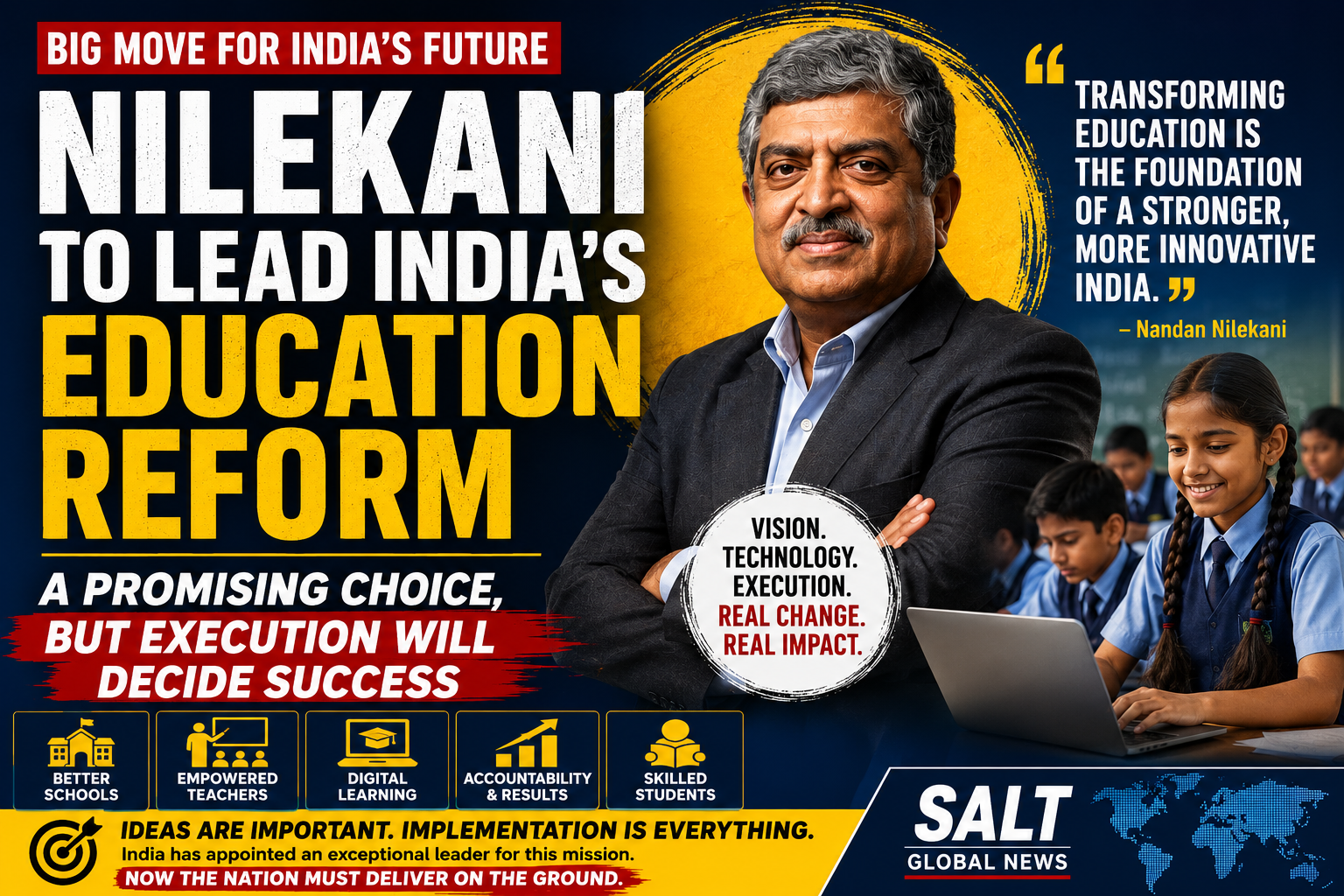
Nilekani to Lead India’s Education Reform: A Promising Choice, but Execution Will Decide Success
Former Reserve Bank of India Governor Dr Raghuram Rajan has been appointed to a Federal Reserve task force reviewing balance sheet policy as part of a comprehensive assessment of the US central bank’s monetary policy framework.
Editorial | Salt Global News
The Government of India’s decision to appoint Nandan Nilekani to lead the country’s education reform initiative has generated considerable optimism. Few individuals have demonstrated the ability to execute complex, nation-wide digital transformation projects as successfully as Nilekani. As the chief architect of Aadhaar, he helped create one of the world’s largest digital identity systems, transforming the delivery of public services to more than a billion Indians.
His appointment reflects the government’s recognition that India’s education system requires bold thinking, technological innovation and long-term structural reform.
However, while the choice of leadership is encouraging, a much larger question remains unanswered:
Will the recommendations be implemented effectively on the ground?
India has never lacked expert committees or task forces. Over the decades, numerous commissions have submitted detailed reports covering curriculum reform, teacher training, digital education, examination systems, skill development and governance. Many of these reports were widely praised, yet a significant number remain partially implemented—or continue to gather dust in government offices.
This has been India’s recurring challenge. The problem is often not the quality of ideas, but the inability to translate those ideas into measurable outcomes.
Education reform is fundamentally an execution challenge.
To transform India’s education system, reforms must reach every classroom, every teacher and every student. Policies announced in New Delhi must be implemented consistently across thousands of districts, millions of schools and diverse state education systems.
This demands far more than visionary leadership.
It requires:
- Strong political commitment at both the Union and State levels.
- A professional implementation team with proven project management experience.
- Greater accountability throughout the education administration.
- Modern digital monitoring systems to measure real progress.
- Recruitment based on expertise rather than bureaucracy alone, including greater use of specialists on fixed-term contracts where appropriate.
- Independent evaluation to ensure reforms produce measurable improvements in learning outcomes.
Nilekani’s greatest contribution may not be limited to recommending reforms. His real strength lies in building scalable systems, using technology to improve governance and creating transparent mechanisms that reduce inefficiency.
The Aadhaar programme demonstrated that India can execute projects of extraordinary scale when leadership, technology and political commitment work together. Whether education reform can replicate that success will depend on whether governments are prepared to adopt the same disciplined approach to implementation.
India’s future economic competitiveness depends on the quality of its education system. The country possesses one of the world’s youngest populations, but demographic advantage alone is not enough. Without better schools, modern curricula, skilled teachers and stronger vocational pathways, India risks falling behind in an increasingly technology-driven global economy.
The appointment of Nandan Nilekani is therefore an encouraging beginning—but it is only the beginning.
The true measure of success will not be another impressive report or another well-written policy document. It will be visible in classrooms where children receive better education, teachers are empowered with modern tools, and students graduate with skills relevant to the twenty-first century.
India has appointed an exceptional leader for this mission.
Now the nation must demonstrate an equal commitment to execution.
Only then can education reform become the foundation of a stronger, more innovative and truly developed India.
Share this post :
Facebook
Twitter
LinkedIn
Pinterest
Latest News
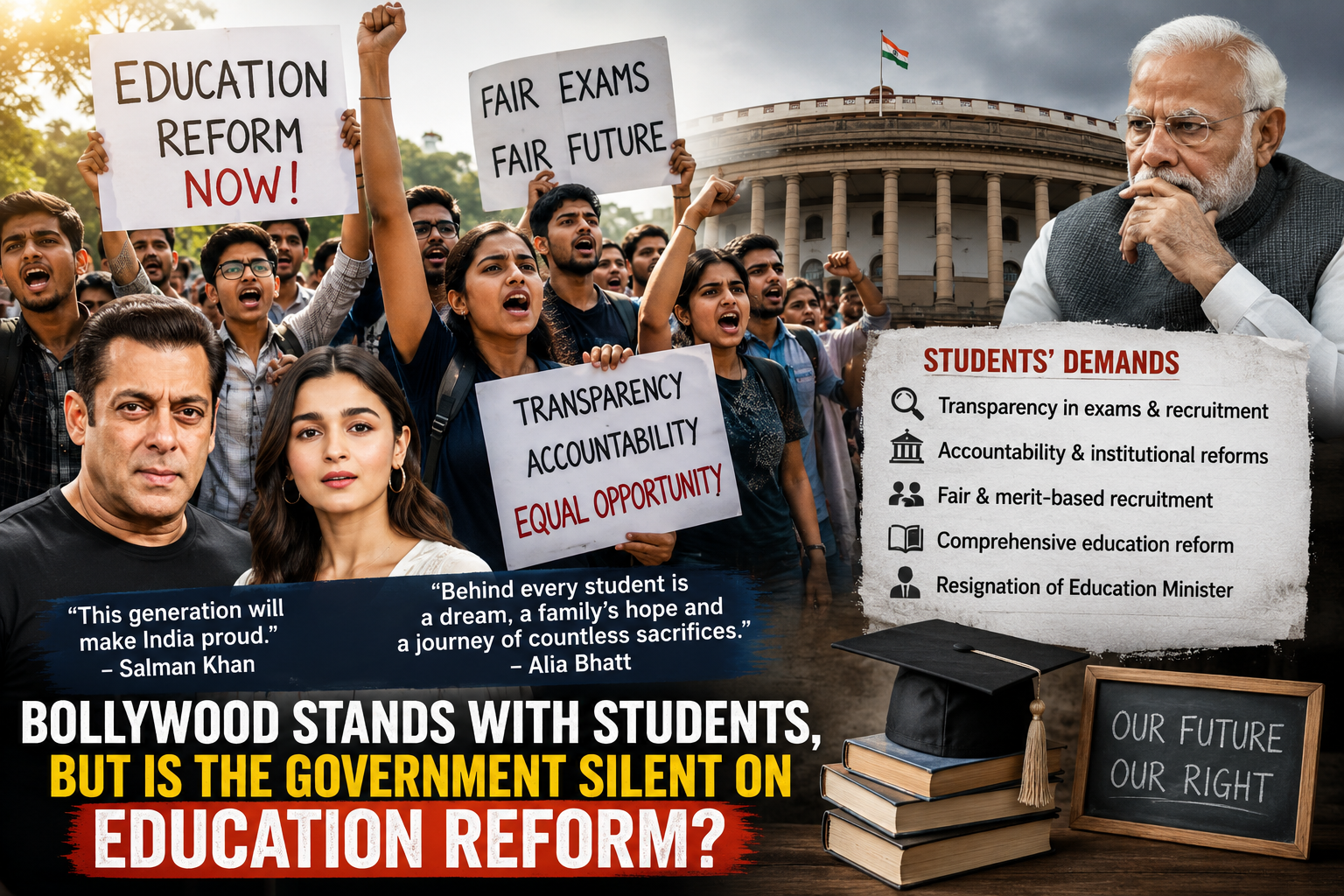
Bollywood Voices Support Students, But the Debate Returns to Education Reform
July 25, 2026
No Comments
India’s Student Revolt: Beyond Political Blame, the Nation Needs Educational Reform
July 24, 2026
No Comments
Editorial | India’s Education Crisis Demands Dialogue, Not Division
July 23, 2026
No Comments