


India’s Student Revolt: Beyond Political Blame, the Nation Needs Educational Reform
Former Reserve Bank of India Governor Dr Raghuram Rajan has been appointed to a Federal Reserve task force reviewing balance sheet policy as part of a comprehensive assessment of the US central bank’s monetary policy framework.
By the Editorial Board | Salt Global News
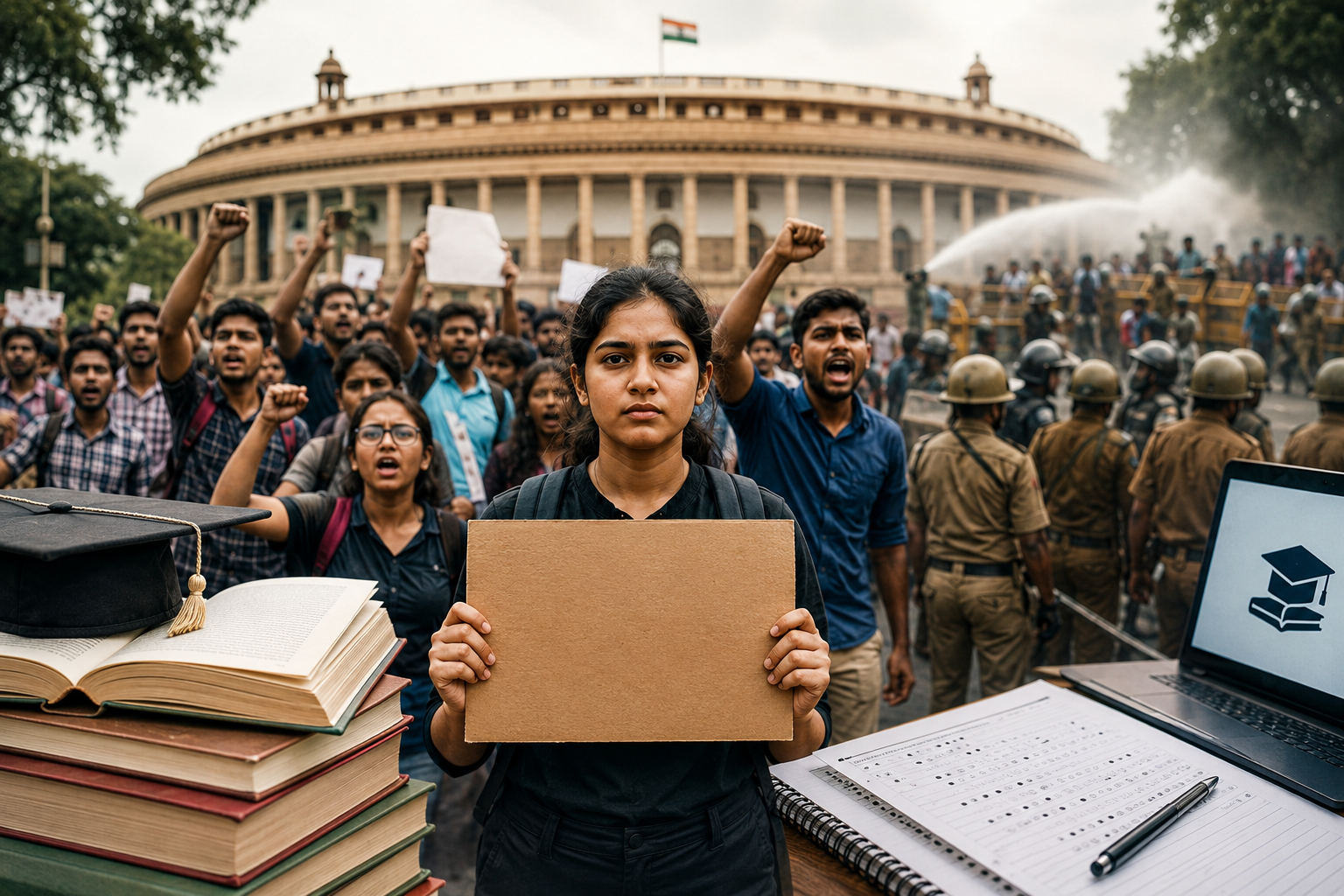
India is witnessing one of the most significant student-led movements in recent years. The demonstrations, fuelled by allegations of examination irregularities, paper leaks, concerns over the quality of education and growing frustration about employment opportunities, have developed into a broader debate over the future of the country’s education system. The events surrounding the student march towards Parliament on 20 July, during which protesters reportedly faced police action, have further intensified public concern.
In the midst of this growing crisis, two of India’s most influential political leaders have offered sharply contrasting public responses through their social media platforms.
Prime Minister Narendra Modi stated that “nothing is more important than the welfare and future of our youth,” announcing the establishment of fast-track courts to ensure swift punishment for those involved in examination paper leaks. He also assured that the government would take all necessary steps to safeguard the interests of students.
Leader of the Opposition Rahul Gandhi, however, argued that the crisis goes much deeper than isolated incidents. In his post, he accused the government of allowing the education system to deteriorate and supported the students’ demands, including the resignation of Education Minister Dharmendra Pradhan, an apology to students, and action against those responsible for alleged assaults on protesters.
Both statements reflect very different political approaches. Yet neither, on its own, provides a complete answer to a crisis that has been developing over many years.
Resignation Is Not Reform
Calls for ministerial resignation are common in democratic politics. They may establish political accountability when a minister is believed to bear responsibility for systemic failures. However, resignation alone does not repair institutions.
India’s education challenges did not emerge overnight, nor can they be solved by replacing one individual. The country has witnessed repeated allegations of examination paper leaks, inconsistent recruitment processes, shortages of qualified teachers, outdated curricula, unequal access to quality education, and a widening gap between university qualifications and employment opportunities.
If one minister resigns while the underlying institutions remain unchanged, students are unlikely to see meaningful improvement.
Political accountability matters. Institutional reform matters even more.
Government Action Must Go Beyond Criminal Prosecution
The Prime Minister’s announcement of fast-track courts represents a positive step towards ensuring quicker justice in cases involving examination fraud. Individuals responsible for organised paper leaks should indeed face swift and severe legal consequences.
However, criminal prosecution addresses only one symptom of a much larger problem.
Students are demanding confidence in an education system that is transparent, merit-based and capable of preparing them for future employment. They seek assurance that years of study will not be undermined by corruption or administrative failures.
Fast-track courts cannot, by themselves, modernise examination systems, improve universities, enhance teaching standards or create employment opportunities for graduates.
The Cost of Confrontation
Equally concerning are reports of police action during student demonstrations. In every democratic society, governments have a responsibility to maintain public order. At the same time, peaceful protest is a legitimate democratic right.
Where allegations of excessive force arise, they deserve impartial investigation. Governments strengthen democratic institutions not by suppressing dissent but by engaging with it openly and transparently.
Students should be heard, not merely managed.
A National Conversation Is Needed
India’s education system serves millions of young people and will shape the country’s economic and social future for decades to come.
Rather than allowing the issue to become another contest between government and opposition, this moment presents an opportunity for comprehensive national reform involving educators, universities, employers, students, state governments and independent experts.
Such reforms should include:
- Modern, secure digital examination systems with independent oversight.
- Strong legal accountability for organised examination fraud.
- Greater transparency in recruitment and admissions.
- Investment in teacher training and higher education.
- Curriculum reforms aligned with emerging technologies and future employment.
- Independent review mechanisms to restore public confidence.
The Missing Conversation: Artificial Intelligence
One area receiving surprisingly little political attention is the transformative role that artificial intelligence could play in education.
AI has the potential to improve examination security through biometric verification, behavioural monitoring and encrypted digital testing. It can detect unusual examination patterns, identify organised cheating networks and significantly reduce opportunities for paper leaks.
Beyond examinations, AI can personalise learning, support teachers, identify struggling students at an early stage and better align educational outcomes with labour market needs.
If India aspires to become a global technology leader, its education system must embrace technological innovation alongside institutional reform.
Our View
The current student movement should not be viewed simply as another political controversy.
It reflects a deeper loss of confidence among young people in one of the country’s most important public institutions.
The Prime Minister has emphasised enforcement. The Opposition has demanded accountability.
Both perspectives have merit.
But India’s students deserve something larger than political confrontation.
They deserve a long-term national strategy that restores trust in education, protects the integrity of examinations, embraces technological innovation, safeguards democratic rights and prepares the next generation for an increasingly competitive global economy.
History will not judge this moment by the number of speeches delivered or resignations demanded.
It will judge whether India’s political leadership—government and opposition alike—used this crisis as an opportunity to build an education system worthy of the aspirations of more than a billion people.
Editorials published by Salt Global News represent the collective opinion of the Editorial Board. They are intended to encourage informed public debate and are distinct from factual news reporting
Share this post :
Facebook
Twitter
LinkedIn
Pinterest
Latest News

₹22,006 Crore vs ₹6.25 Crore: Inside the Subhash Chandra Insolvency Controversy
September 1, 2026
No Comments

Can America Really Isolate Iran? The Limits of Economic Warfare in a Divided World
August 27, 2026
No Comments

Artificial Intelligence Must Serve Humanity, Not Just Shareholders
August 7, 2026
No Comments