


Global Markets at a Crossroads: Are Falling Gold Prices, Weaker Oil and the AI Boom Signaling a New Economic Era?
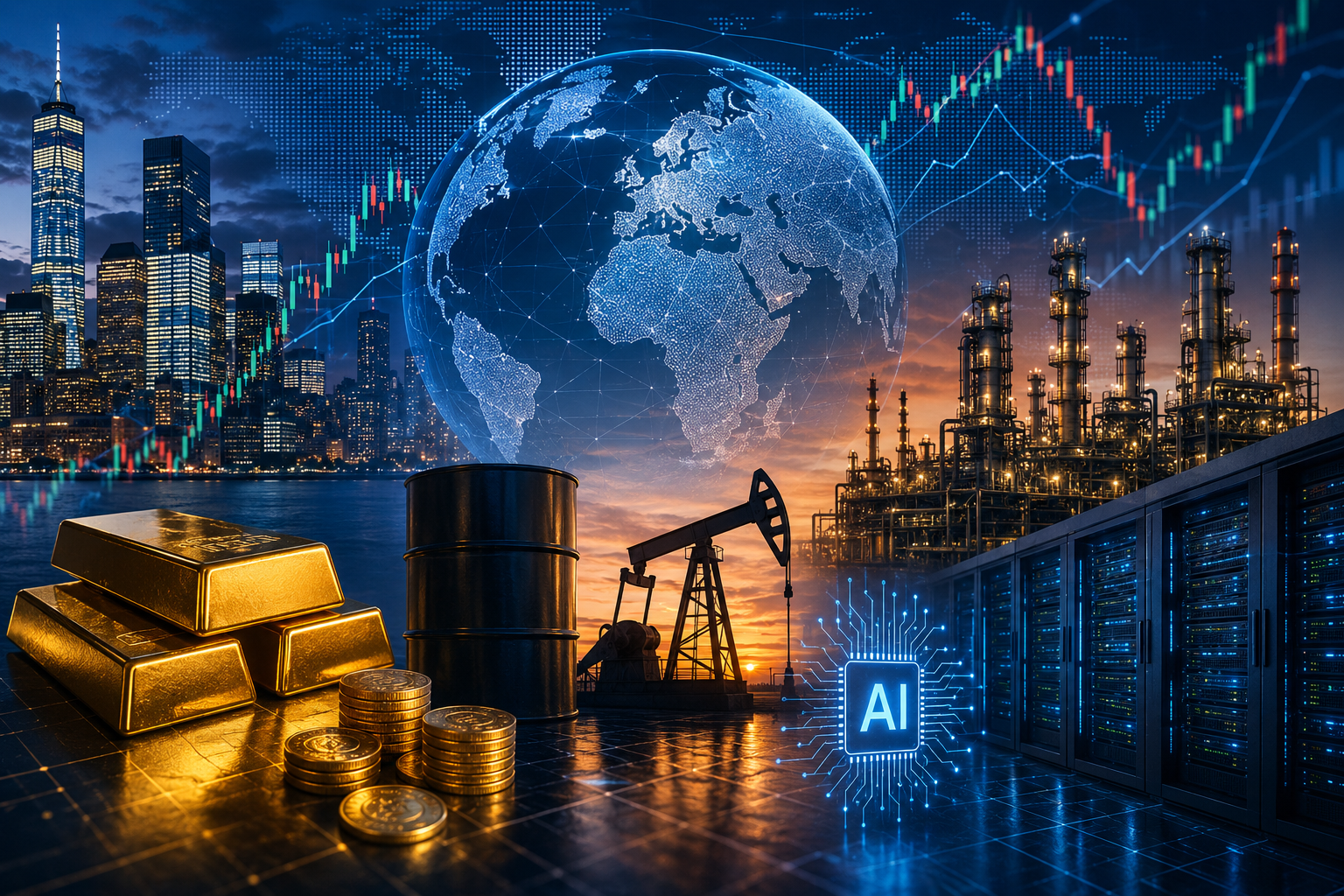
Gold prices are retreating, crude oil has weakened, artificial intelligence investment continues to surge, while United States Treasury yields remain stubbornly high. Together, these seemingly contradictory market signals are raising fresh questions about the health of the global economy. Are they early warnings of another major recession, or evidence that the world is adjusting to a fundamentally different economic landscape? Global English News examines the latest economic trends, the views of leading economists and what investors should expect over the coming year.
The global economy has entered a period of slower—but still positive—growth. Financial markets remain volatile, yet the available evidence does not currently support comparisons with either the Global Financial Crisis of 2008 or the Great Depression of the 1930s.
Instead, governments, businesses and investors are navigating a world characterised by higher interest rates, geopolitical fragmentation, rapid technological innovation, record levels of public debt and profound structural change.
The next twelve to eighteen months are likely to determine whether the global economy achieves a soft landing or slips into a broader slowdown.
Key Takeaways
- A global recession is not currently the most likely scenario.
- High levels of public debt remain one of the world’s largest structural economic risks.
- Elevated US Treasury yields continue to tighten global financial conditions.
- Lower crude oil prices are providing welcome relief to energy-importing economies, particularly India.
- Artificial Intelligence is boosting productivity and investment but may also be creating pockets of excessive market valuation.
- Central bank decisions during the coming year will remain the most important influence on global financial markets.
Four Economic Signals Investors Cannot Ignore
- Gold Prices Are Falling
Gold has traditionally been regarded as a safe-haven asset during periods of uncertainty. However, its recent decline reflects a combination of higher real interest rates, a stronger US dollar and reduced demand for defensive assets.
Rather than signaling that economic risks have disappeared, lower gold prices suggest that investors increasingly expect interest rates to remain elevated for longer, reducing the appeal of non-yielding assets.
- Crude Oil Prices Have Weakened
Lower oil prices generally reduce inflationary pressures, improve household purchasing power and lower operating costs for businesses.
For major energy importers such as India, Japan and much of Europe, declining crude prices strengthen economic fundamentals by reducing import costs and improving corporate profitability.
However, economists caution that a prolonged decline in oil prices could also reflect weaker industrial activity and slowing global demand if accompanied by declining manufacturing output.
- US Treasury Yields Continue to Pressure Global Markets
One of the clearest warning signs for the world economy remains the persistence of elevated US Treasury yields.
Higher government bond yields increase borrowing costs across the global financial system, affecting mortgages, corporate financing and public-sector debt servicing.
The consequences are already becoming evident:
- Higher mortgage and consumer borrowing costs.
- Reduced business investment.
- Slower consumer spending.
Rising government debt-servicing obligations. Should high bond yields persist while economic growth weakens, the risk of recession would increase significantly.
- Artificial Intelligence Is Transforming Global Investment
Artificial Intelligence has become the defining investment theme of the decade.
Technology companies are investing hundreds of billions of dollars in semiconductors, cloud computing, advanced chips, robotics and AI infrastructure.
History demonstrates that transformational technologies create enormous long-term economic value. However, every technological revolution—from railways to the internet—has also experienced periods of excessive investor optimism.
The challenge facing investors today is distinguishing sustainable long-term businesses from speculative market valuations.
What Leading Economists Are Saying
The broad consensus among international organisations, central banks and leading economists remains remarkably consistent.
Global economic growth is expected to continue, albeit at a slower pace than in previous years.
Inflation is gradually moderating across many advanced economies, labour markets remain relatively resilient and banking systems are considerably stronger than they were before the 2008 financial crisis.
Nevertheless, tighter financial conditions, record public debt and geopolitical uncertainty are expected to limit global growth.
Most economists therefore anticipate slower expansion rather than a severe worldwide recession.
The Biggest Risks Facing the Global Economy
Despite encouraging signs in some sectors, significant risks remain.
The principal challenges include:
- Escalating geopolitical tensions.
- Record global government debt.
- Persistent inflation in several major economies.
- High valuations across parts of the technology sector.
- Continued weakness in China’s property market.
- Fragmentation of global trade.
- Climate-related economic disruption.
- Growing cybersecurity threats.
- Uncertainty surrounding Artificial Intelligence regulation.
While none of these factors individually guarantees recession, together they have the potential to weaken global economic growth over the coming years.
India’s Position in the Global Economy
India continues to stand out as one of the world’s strongest-performing major economies.
Several structural advantages continue to support long-term growth:
- Strong domestic consumption.
- Record infrastructure investment.
- Rapid digital transformation.
- Expanding manufacturing capacity.
- Increasing foreign direct investment.
- A young and favourable demographic profile.
Lower crude oil prices further strengthen India’s economic outlook by reducing inflationary pressures and improving the country’s current account balance.
Nevertheless, India remains vulnerable to slower export demand and weaker foreign investment should advanced economies enter recession.
Indicator | Current Trend | Economic Interpretation |
Gold | Falling | Higher real interest rates reduce safe-haven demand |
Crude Oil | Falling | Lower inflation but softer global demand |
US Treasury Yields | Elevated | Tighter global financial conditions |
AI Investment | Rising | Strong innovation alongside valuation risks |
Inflation | Moderating | Positive for consumers and businesses |
Global Trade | Mixed | Slower, but still expanding |
What Investors Should Watch
During the remainder of 2026, the following indicators will provide the clearest signals regarding the direction of the global economy:
- US inflation and employment data.
- Federal Reserve interest-rate decisions.
- European Central Bank policy.
- China’s economic recovery.
- Global corporate earnings.
- Manufacturing activity.
- Shipping and freight costs.
- Commodity price trends.
- Returns on AI-related investments.
- Consumer confidence and labour market conditions.
These indicators will help determine whether the global economy achieves a soft landing or experiences a deeper slowdown.
Editorial Perspective
Financial markets often react sharply to short-term headlines.
Long-term investors, however, focus on economic fundamentals rather than daily market volatility.
Today’s economic environment differs substantially from both the 2008 financial crisis and the pandemic-driven recession of 2020.
Banking systems are better capitalised.
Corporate balance sheets are generally stronger.
Employment remains resilient in many advanced economies.
Technological innovation continues to improve productivity and create new industries.
These strengths provide important resilience, even as governments and businesses confront significant structural challenges.
Conclusion
The defining economic challenge of the next decade will not simply be avoiding recession.
Rather, it will be successfully navigating an increasingly complex global economy shaped by higher borrowing costs, rapid technological innovation, geopolitical competition, demographic change and the transition towards artificial intelligence.
The evidence suggests that the world is entering a new phase of slower, more uneven growth rather than an imminent global economic collapse.
For investors, policymakers and business leaders, success will depend on disciplined decision-making, sound public policy and a willingness to adapt to profound structural change.
At Global English News, we believe the coming decade will reward resilience, innovation and long-term thinking far more than speculation or short-term market sentiment.
About Global English News
Salt Global English News is an independent international publication covering global economics, financial markets, business, technology, geopolitics, public policy and sustainable development. Through fact-based journalism, expert analysis and balanced reporting, our mission is to help readers understand the forces shaping the world economy and the opportunities and challenges that lie ahead.
Share this post :
Facebook
Twitter
LinkedIn
Pinterest
Latest News

₹22,006 Crore vs ₹6.25 Crore: Inside the Subhash Chandra Insolvency Controversy
September 1, 2026
No Comments

Can America Really Isolate Iran? The Limits of Economic Warfare in a Divided World
August 27, 2026
No Comments

Artificial Intelligence Must Serve Humanity, Not Just Shareholders
August 7, 2026
No Comments