


Bollywood Voices Support Students, But the Debate Returns to Education Reform
As celebrities stand with India’s student movement, the spotlight shifts to the government’s response and the need for long-term educational reform.
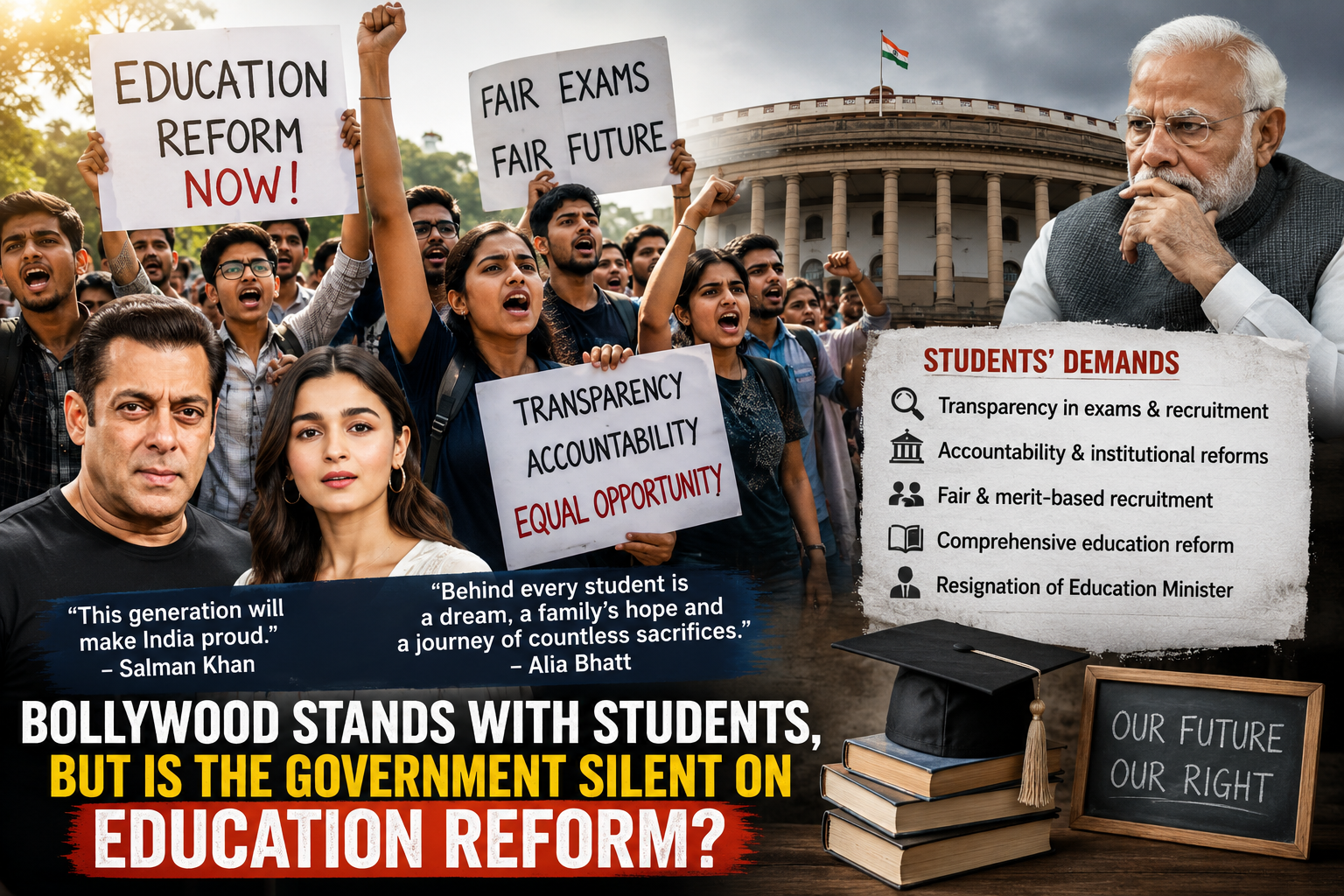
India’s nationwide student movement has entered a new phase, attracting support not only from civil society but also from some of Bollywood’s biggest stars. Public messages from actors Salman Khan and Alia Bhatt have added fresh momentum to a campaign that has increasingly become a national conversation about the future of education rather than simply a political dispute.
According to reports highlighted in the shared newspaper coverage, Salman Khan praised the students for conducting their protest peacefully and courageously, describing them as a generation capable of making India proud. Alia Bhatt also expressed solidarity, saying that behind every student standing their ground lies “a dream, a family’s hope, and a journey of countless sacrifices.”
The support from prominent public figures has broadened the discussion on social media, bringing greater attention to the concerns raised by students across the country.
A Movement About More Than Examination Leaks
While the government has acknowledged concerns surrounding examination paper leaks and announced measures aimed at strengthening the integrity of the examination system, many student organisations argue that their demands extend far beyond isolated incidents.
Protesters have consistently called for wider reforms, including:
- Greater transparency in examinations and recruitment.
- Stronger accountability within educational institutions.
- Fair and merit-based recruitment processes.
- Comprehensive reforms to India’s education system.
- Improved governance and institutional responsibility.
Many students believe that isolated policy announcements will not address what they describe as deeper structural problems affecting education and employment opportunities.
Government Under Pressure
Prime Minister Narendra Modi recently described examination paper leaks as a serious crime and pledged stronger legal measures alongside faster judicial action. These assurances have been welcomed by some observers as an important step towards restoring confidence in public examinations.
However, critics argue that the government’s statements have not fully addressed the broader issues repeatedly raised by protesting students, particularly those concerning systemic reform, institutional accountability and the long-term quality of education.
Celebrity Support Raises Public Awareness
Bollywood’s involvement does not change government policy, but it significantly amplifies public attention.
When influential cultural figures speak in support of peaceful democratic participation, they encourage wider debate and help ensure that issues affecting young people remain part of the national conversation. Their statements also underline that education is not merely a political issue—it is a social and economic priority with consequences for the country’s future.
Education Reform: The Real National Challenge
India has one of the world’s largest youth populations. The quality, fairness and credibility of its education system will shape not only individual careers but also the nation’s economic growth, innovation and global competitiveness.
Public confidence in examinations, recruitment and educational governance is essential. Without meaningful reform, repeated crises risk undermining trust in institutions that millions of young people rely upon.
The current protests therefore present an opportunity as much as a challenge. Constructive dialogue between students, educators and policymakers could help transform public frustration into lasting reform.
The Way Forward
Peaceful protest remains an important democratic right. Equally important is the willingness of governments to engage with genuine public concerns through transparent consultation and effective policy action.
Whether the present movement results in meaningful educational reform will depend not on celebrity endorsements or political exchanges alone, but on sustained dialogue and a commitment to addressing the structural issues identified by students.
As India looks towards the future, the central question remains unchanged:
Will the current momentum lead to comprehensive education reform, or will it become another missed opportunity to rebuild confidence in one of the country’s most important public institutions?
Share this post :
Facebook
Twitter
LinkedIn
Pinterest
Latest News

₹22,006 Crore vs ₹6.25 Crore: Inside the Subhash Chandra Insolvency Controversy
September 1, 2026
No Comments

Can America Really Isolate Iran? The Limits of Economic Warfare in a Divided World
August 27, 2026
No Comments

Artificial Intelligence Must Serve Humanity, Not Just Shareholders
August 7, 2026
No Comments