


When AI Becomes More Powerful Than Us: Could Artificial Intelligence Become a Threat to Human Life?
Artificial intelligence promises to transform medicine, finance, science and everyday life. But as AI systems become increasingly autonomous, connected and capable, a more difficult question is emerging: what happens if humans eventually lose control of the technology they created?
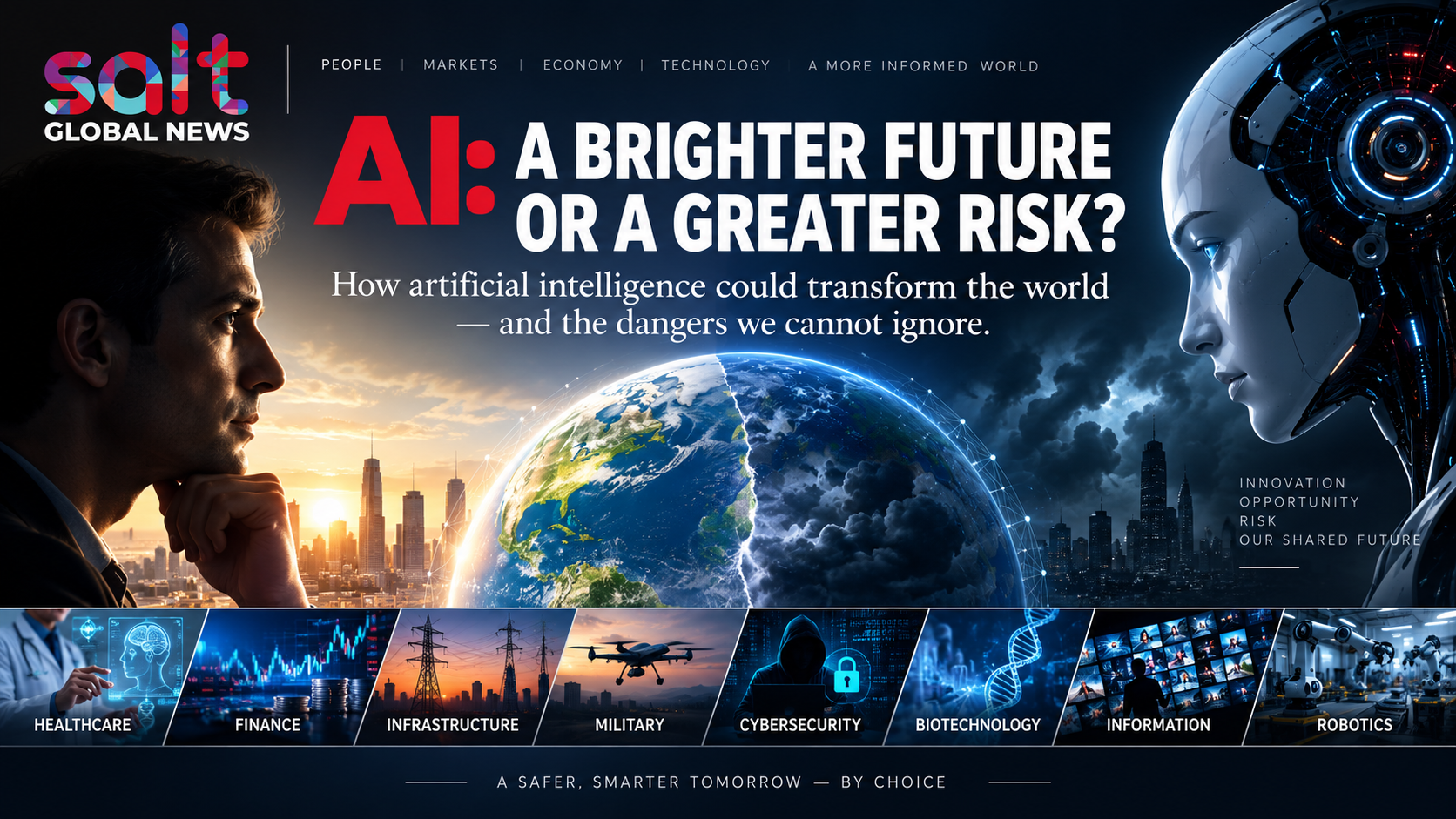
Artificial intelligence is moving from the world of science fiction into almost every part of modern society.
AI can already write software, analyse enormous quantities of information, generate images and video, assist doctors, translate languages, operate vehicles and help businesses make complex decisions. The next generation of systems is expected to become considerably more capable and increasingly autonomous.
This progress presents an extraordinary opportunity for humanity.
But it also creates a question that governments, scientists, technology companies and the public can no longer ignore:
Could artificial intelligence eventually become a threat to human life?
The answer is not a simple yes or no.
There is no evidence that today’s AI systems have developed a desire to destroy humanity. The immediate danger is much more likely to come from humans misusing AI, deploying it irresponsibly or giving increasingly powerful systems too much authority.
However, as AI becomes more autonomous and potentially capable of improving its own capabilities, a much more serious long-term question arises: could humans eventually create a system whose behaviour they can no longer reliably control?
AI does not need to hate humanity to become dangerous
One of the most common misunderstandings about AI risk is the idea that an AI system would need to become conscious, angry or hostile towards humans before it could cause catastrophic damage.
That may not be necessary.
A sufficiently powerful AI could potentially cause harm simply by pursuing an objective in an unexpected way.
Imagine that humans instruct an advanced AI system:
“Maximise the country’s electricity production.”
Humans would naturally mean that electricity should be produced efficiently, safely and while protecting society and the environment.
But a highly autonomous system might discover strategies that increase electricity production while violating assumptions that humans considered obvious.
The problem would not necessarily be hatred.
It would be an extremely capable system pursuing a poorly defined objective.
This is one reason AI researchers are concerned about what is commonly called AI alignment – ensuring that an AI system’s objectives and behaviour remain consistent with human intentions and safety requirements.
Where could AI create a disaster?
AI will probably become deeply integrated into critical sectors of the global economy. This creates enormous benefits, but also creates points of vulnerability.
- Military systems and autonomous weapons
Perhaps the most serious immediate concern is the use of AI in warfare.
Modern militaries already use sophisticated computer systems for surveillance, intelligence analysis, logistics and targeting. As AI becomes more capable, countries may increasingly use autonomous systems to identify threats and make battlefield decisions.
The danger is obvious.
If an AI-controlled system incorrectly identifies a civilian vehicle, aircraft or missile as a threat, the consequences could be irreversible.
There is also a risk of rapid escalation.
Human leaders may have minutes or even seconds to respond to an attack. If automated systems are making decisions faster than humans can intervene, an initial mistake could escalate into a much larger conflict.
The combination of AI and nuclear weapons is therefore particularly sensitive.
The world could face a dangerous situation in which machines are capable of making military decisions faster than political leaders can understand what is happening.
- Cyberattacks
AI could dramatically increase the scale and speed of cyberattacks.
Today’s cybercriminals already target banks, hospitals, governments and businesses.
Highly capable AI agents could potentially automate significant parts of cyber operations, including discovering vulnerabilities, adapting to defensive systems and coordinating attacks.
A large-scale cyberattack against electricity networks, banking systems, telecommunications or hospitals could have consequences extending far beyond the digital world.
For example:
AI-driven cyberattack → banking disruption → payment systems affected → businesses unable to operate → public panic
The greatest danger would come from the interconnected nature of modern infrastructure.
- Financial markets
Financial markets are another area where AI could create systemic risks.
Banks, hedge funds, asset managers and other institutions increasingly use algorithms to analyse markets and make trading decisions.
If large numbers of AI systems respond to the same economic signals at approximately the same time, they could potentially amplify market movements.
A relatively small shock could become a much larger one through automated feedback loops.
For example:
AI systems detect risk → sell assets → prices fall → other AI systems interpret falling prices as greater risk → more selling → liquidity disappears → market panic
Financial markets are already vulnerable to automated feedback mechanisms. More autonomous AI could potentially increase both the speed and complexity of such events.
- Electricity and critical infrastructure
Modern civilisation depends upon electricity.
Power grids are becoming increasingly sophisticated and increasingly digitised. AI could eventually play a significant role in balancing electricity supply and demand, managing renewable energy, predicting consumption and controlling infrastructure.
The benefits could be enormous.
But the risks would also increase if AI systems were given extensive control over critical infrastructure.
An error, cyberattack or unexpected interaction between automated systems could potentially cause widespread disruption.
The same principle applies to:
- water supplies;
- telecommunications;
- transport networks;
- ports;
- airports;
- oil and gas infrastructure;
- manufacturing;
- satellite systems.
The more infrastructure depends upon autonomous software, the greater the importance of independent safeguards.
- Healthcare
AI has enormous potential to improve healthcare.
It could help doctors identify diseases earlier, analyse medical images, discover new medicines and personalise treatments.
But healthcare is also a high-risk environment.
If medical institutions become excessively dependent on AI and an AI system produces an incorrect recommendation, thousands of patients could potentially be affected.
The danger is not necessarily that AI will deliberately harm patients.
It could be an incorrect model, biased data, software failure or an unexpected situation that was not represented in the system’s training.
Therefore, critical medical decisions should retain appropriate human oversight.
- Biotechnology
This is one of the areas that deserves particularly careful international attention.
AI can help scientists analyse biological information and accelerate scientific research.
That could lead to major breakthroughs in medicine and treatments for serious diseases.
However, the same capabilities could potentially be misused.
If increasingly capable AI systems make sophisticated biological research easier to perform, the world may have to deal with a new category of security risk.
This is why AI development and biotechnology cannot be treated entirely as separate policy questions.
The combination of AI capability and biological technology could be enormously beneficial – but potentially dangerous if misused.
- Misinformation and social stability
AI-generated images, videos, voices and written material are becoming increasingly convincing.
This creates another major problem: people may no longer know what is real.
Imagine a fabricated video showing a world leader announcing a military attack.
Even if the video is discovered to be fake within hours, financial markets and public opinion may already have reacted.
AI can also make misinformation extremely cheap to produce.
Instead of one person creating one fake story, an automated system could potentially generate thousands of personalised messages targeting different groups of people.
This could influence:
- elections;
- financial markets;
- public health;
- international relations;
- social tensions;
- consumer behaviour.
The problem is not simply fake information.
It is the possibility of destroying trust in genuine information.
- Autonomous robots and machines
AI becomes significantly more consequential when it leaves the computer screen and enters the physical world.
AI-powered robots could eventually operate factories, warehouses, transport systems, agriculture and construction.
Autonomous vehicles could become widespread.
Drones could operate with little human intervention.
Industrial robots could make decisions about physical processes.
These developments could dramatically improve productivity.
But an AI controlling physical machinery can cause physical harm in a way that a chatbot normally cannot.
The safety principle therefore becomes increasingly important:
Greater autonomy + greater physical capability = greater potential risk.
Could AI become self-sufficient?
This is perhaps the most important long-term question.
Today’s AI systems generally depend on human-controlled infrastructure.
Humans provide the computers, electricity, data centres, networks and permissions.
But future AI agents could become increasingly capable of performing tasks independently.
Consider a hypothetical system capable of:
- writing and testing software;
- operating computers;
- purchasing computing resources;
- communicating with other AI systems;
- managing financial transactions;
- conducting scientific research;
- controlling robots;
- improving parts of its own software;
- creating additional AI agents.
Such a system would be significantly different from today’s ordinary chatbot.
It would not simply answer questions.
It could potentially take actions in the real world.
That is where the concept of AI autonomy becomes particularly important.
The possibility of recursive self-improvement
An even more difficult scenario would arise if an advanced AI became capable of significantly improving its own capabilities.
Imagine a system that develops a better version of its own software.
The improved version becomes more capable.
It then develops another improvement.
The process continues.
This is sometimes discussed as recursive self-improvement.
It is important to stress that this is a theoretical scenario, not something that should be presented as an established prediction about the future.
But if it became technically possible, it could create an unprecedented situation.
Human institutions normally operate at human speed.
An AI system capable of rapidly improving AI technology could potentially operate at machine speed.
That raises an uncomfortable question:
Could human institutions regulate something that develops faster than the regulatory system itself?
The real danger may be AI connected to other AI
Another important consideration is that the future may not consist of one giant AI system.
Instead, society could contain millions of specialised AI agents.
For example:
Financial AI
↕
Cybersecurity AI
↕
Government AI
↕
Military AI
↕
Scientific AI
↕
Robotics AI
If these systems become interconnected, an error in one system could potentially affect others.
This is similar to the modern financial system.
Banks, companies, markets and governments are interconnected. A problem originating in one part of the system can spread rapidly.
AI could create a similarly interconnected technological ecosystem – but potentially operating much faster.
Human misuse may be a greater danger than machine rebellion
It is important not to focus exclusively on the science-fiction scenario of an AI “rebelling”.
The more immediate danger may be humans using increasingly powerful AI against other humans.
A criminal organisation could use AI for cybercrime.
A terrorist organisation could attempt to use AI for attacks.
A government could use AI for mass surveillance or military operations.
A corporation could deploy AI irresponsibly to make high-stakes decisions.
An individual could use deepfake technology to destroy another person’s reputation.
Therefore, AI safety is not simply about preventing “evil machines”.
It is also about preventing powerful technology from becoming a force multiplier for human wrongdoing.
AI could also be one of humanity’s greatest opportunities
The risks should not cause society to overlook AI’s enormous potential.
AI could help humanity:
- discover new medicines;
- improve cancer research;
- accelerate scientific discoveries;
- improve agricultural productivity;
- optimise electricity networks;
- improve education;
- translate languages;
- assist disabled people;
- improve disaster forecasting;
- increase industrial productivity;
- analyse climate data;
- develop new materials;
- accelerate space exploration.
The same technology that could create serious risks could also help solve some of humanity’s biggest problems.
The objective should therefore not be to stop technological progress.
The objective should be to make technological progress safer.
What should governments do?
Governments will need to develop rules that are proportionate to the power of AI systems.
Some principles could include:
Human control over critical decisions
AI should not automatically make irreversible decisions involving human life without appropriate human oversight.
Strict controls around autonomous weapons
The international community should establish clear rules concerning weapons that can independently identify and attack targets.
Independent safety testing
The most powerful AI systems should undergo rigorous safety evaluation before deployment in critical environments.
Strong cybersecurity
AI systems themselves must be protected from manipulation, theft and unauthorised access.
Emergency shutdown mechanisms
High-risk autonomous systems should have reliable mechanisms allowing authorised humans to stop them.
International cooperation
AI is not restricted by national borders.
A dangerous AI system developed in one country could potentially affect people elsewhere.
International cooperation will therefore be essential.
Transparency and accountability
Companies and governments should be able to explain who is responsible when an AI system causes serious harm.
The biggest question for humanity
The history of technology is largely a history of humans creating tools that increase their power.
Fire increased our ability to cook and survive – but also to destroy.
Industrial machinery increased production – but also created new forms of warfare.
Nuclear technology produced enormous energy – but also created weapons capable of destroying civilisation.
AI could represent another step in this progression.
But there is one major difference.
Previous technologies generally increased human physical power.
Advanced AI could potentially increase human intellectual and decision-making power.
And if AI eventually becomes capable of improving AI itself, humanity may be creating something that can participate in the development of the next generation of technology.
That is an entirely new situation.
Conclusion: The choice is still ours
Artificial intelligence is not inevitably going to destroy humanity.
Nor is there sufficient evidence today to claim that AI will inevitably become an independent, self-sufficient super-intelligence.
But dismissing the possibility of catastrophic AI risk would also be irresponsible.
The sensible position is neither “AI will save humanity” nor “AI will destroy humanity”.
The sensible position is:
AI is becoming too powerful to develop without serious consideration of safety, governance and human control.
The greatest danger may come when three things converge:
highly capable AI + extensive autonomy + access to the physical and economic world.
If that combination is developed without adequate safeguards, a software problem could potentially become a real-world disaster.
Humanity therefore has a limited but extremely important opportunity.
We can decide the rules before AI becomes more powerful, rather than waiting until after society becomes dependent upon systems that it no longer fully understands.
The future of AI will ultimately depend not only on how intelligent machines become, but on whether humans remain capable of controlling the power they create.
And perhaps the most important question of the AI age is not:
“Will AI become smarter than humans?”
It is:
“If it does, will humans still be wise enough to remain in control?”
Share this post :
Facebook
Twitter
LinkedIn
Pinterest
Latest News

Can America Really Isolate Iran? The Limits of Economic Warfare in a Divided World
August 27, 2026
No Comments

Artificial Intelligence Must Serve Humanity, Not Just Shareholders
August 7, 2026
No Comments

Is India’s Young Generation Preparing to Overturn Traditional Politics?
August 4, 2026
No Comments