


Fed Holds Rates Steady, but Inflation Warning Grows: Is the U.S. Central Bank Preparing for a September Rate Hike?
Former Reserve Bank of India Governor Dr Raghuram Rajan has been appointed to a Federal Reserve task force reviewing balance sheet policy as part of a comprehensive assessment of the US central bank’s monetary policy framework.
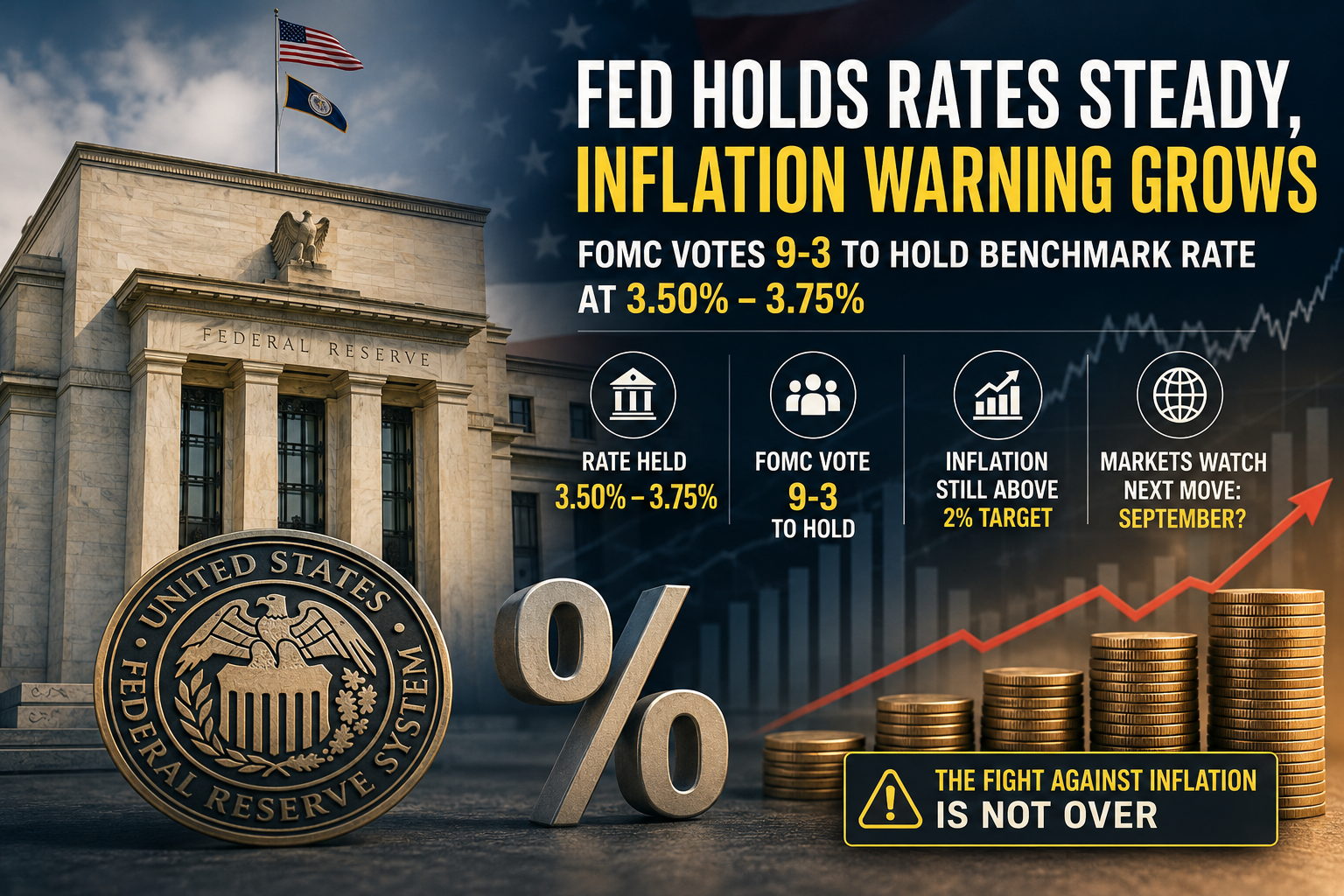
The U.S. Federal Reserve has chosen caution over action, leaving its benchmark federal funds rate unchanged at 3.50%–3.75% following the latest meeting of the Federal Open Market Committee (FOMC). However, beneath the headline decision lies a significant shift in the policy debate: the committee voted 9-3 to keep rates unchanged, with three members dissenting in favour of an immediate 25-basis-point increase. This is one of the most divided votes seen in recent years and highlights growing concern within the central bank that inflationary pressures remain far from defeated.
For investors, governments and businesses worldwide, the message is clear: while the Fed has paused today, it is not signalling that the fight against inflation is over.
Inflation Remains the Fed’s Biggest Challenge
The Federal Reserve acknowledged that inflation continues to run above its long-term target of 2%. Policymakers pointed to persistent supply-side pressures, particularly higher energy prices linked to geopolitical tensions in the Middle East, as well as resilient domestic demand. The U.S. economy continues to expand at a solid pace, supported by strong productivity growth and business investment, while unemployment remains relatively low.
Normally, such economic strength would justify tighter monetary policy. However, Fed Chair Kevin Warsh appears determined to gather additional evidence before raising borrowing costs again.
Why Three Officials Wanted Higher Rates
The three dissenting policymakers—Beth Hammack, Neel Kashkari and Lorie Logan—argued that inflation has remained above target for too long and that delaying action could make future inflation more difficult to control. Their preference for an immediate quarter-point increase reflects concern that inflation expectations could become entrenched if the Fed appears hesitant.
Such public disagreement inside the FOMC is unusual and suggests that internal pressure for tighter policy is increasing.
Economists See a Hawkish Pause
Leading economists broadly describe the latest decision as a “hawkish hold.”
According to J.P. Morgan Wealth Management, inflation may gradually ease without additional rate increases if energy prices stabilise and wage growth remains contained. On the other hand, economists at the Competitive Enterprise Institute believe the Fed may have little choice but to raise rates in September if inflation data fail to improve. Market strategists also note that rising oil prices and geopolitical uncertainty complicate the inflation outlook.
The Federal Reserve’s own Monetary Policy Report similarly emphasises that inflation has risen this year because of supply shocks, particularly in energy markets, while the labour market remains resilient.
Financial Markets React Calmly
Financial markets interpreted the decision as expected.
- U.S. equities recovered after initial weakness.
- Treasury yields edged higher as investors priced in the possibility of tighter policy later this year.
- The U.S. dollar weakened modestly after the announcement.
- Interest-rate futures now indicate increasing expectations that the Fed could raise rates as early as September if inflation remains elevated.
The market reaction suggests investors believe the Fed’s next move is more likely to be a rate increase than a rate cut.
Global Implications
Because the U.S. dollar remains the world’s reserve currency, every Federal Reserve decision has international consequences.
Higher U.S. interest rates generally strengthen the dollar, increase borrowing costs for emerging markets, reduce global capital flows into developing economies and place downward pressure on commodity prices. Countries carrying large amounts of dollar-denominated debt may also face higher financing costs.
For economies such as India, sustained higher U.S. interest rates could:
- increase pressure on the rupee,
- raise imported inflation through energy prices,
- reduce foreign portfolio investment,
- increase corporate borrowing costs, and
- complicate monetary policy decisions for the Reserve Bank of India.
Looking Ahead: September Could Be Decisive
The Federal Reserve has deliberately avoided committing to its next move, instead stressing that future decisions will depend on incoming economic data.
Key indicators that policymakers will monitor include:
- Consumer Price Index (CPI) inflation,
- Personal Consumption Expenditure (PCE) inflation,
- labour market data,
- wage growth,
- oil and energy prices, and
- broader geopolitical developments.
If inflation fails to moderate over the coming weeks, a September rate hike appears increasingly likely.
Editorial View
The Federal Reserve’s latest decision represents not a victory over inflation but a strategic pause in one of the most challenging monetary policy environments in decades. With inflation still above target, energy markets under pressure and the global economy facing geopolitical uncertainty, the 9-3 vote reveals a central bank that is becoming increasingly divided over how aggressively it should respond.
For global investors, businesses and policymakers, the message is unmistakable: the era of restrictive monetary policy is not yet over. Unless inflation shows convincing signs of easing, the Federal Reserve may soon be forced to resume tightening—making September one of the most closely watched policy meetings of the year.
Share this post :
Facebook
Twitter
LinkedIn
Pinterest
Latest News

₹22,006 Crore vs ₹6.25 Crore: Inside the Subhash Chandra Insolvency Controversy
September 1, 2026
No Comments

Can America Really Isolate Iran? The Limits of Economic Warfare in a Divided World
August 27, 2026
No Comments

Artificial Intelligence Must Serve Humanity, Not Just Shareholders
August 7, 2026
No Comments